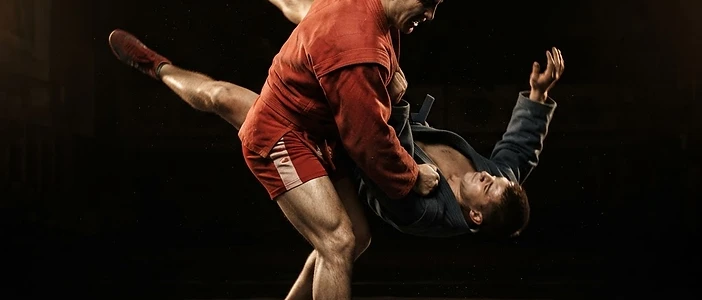
Sambo is the Soviet Union's synthesized combat system — a fusion of judo, wrestling, and national republic styles forged in the 1920s–30s. Its name, an acronym for 'self-defense without weapons,' reflects its military origin.
Recognized as an official Soviet sport in 1938, sambo produced some of the world's most formidable grapplers and became the backbone of Russian MMA. It blends jacket throws with leg locks and aggressive ground offense.
The Philosophy
Throw fast, finish faster. Sambo blends the jacket throws of judo with the leg-lock aggression western grappling long avoided. Its combat (combat sambo) variant includes strikes, making it a complete system.
Synthesis Begins
Vasili Oshchepkov and Viktor Spiridonov synthesize judo, wrestling, and regional styles into a Soviet military system.
Official Recognition
Sambo is recognized as an official sport of the USSR, with a unified ruleset and national championships.
FIAS Roots
International sambo federation structures begin to form, spreading the sport beyond the Soviet bloc.
Olympic Push
Sambo is demonstrated at the Moscow 1980 Olympics as a showcase Soviet discipline.
MMA Export
Sambo-trained fighters like Fedor Emelianenko and Khabib Nurmagomedov dominate global MMA.
GAISF Recognition
Sambo gains provisional recognition from the Global Association of International Sports Federations.
Sambo's modern era is defined by its outsized influence on MMA, where its leg-lock entries and jacket-throw takedowns are prized. The FIAS World Championships and continental circuits keep the sport internationally competitive, while combat sambo offers a complete-ruleset pathway.